

Self Project
A clear, concise overview highlighting the essence of your work
AutoCAD Designs and Researches
Introduction
This section presents a set of learning and analysis-based projects completed over a one-month period, combining practical engineering concepts with analytical and documentation skills. These works focus on understanding real-world applications through detailed study, breakdown, and structured presentation.
The projects include electrical circuit design, financial data analysis, and technical report writing, reflecting a multidisciplinary approach that integrates engineering knowledge with data interpretation and professional communication.
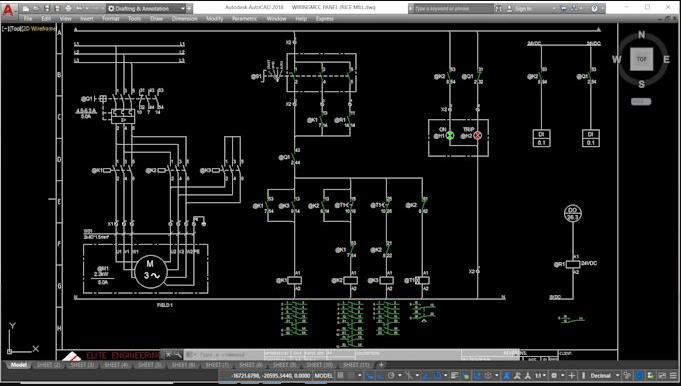
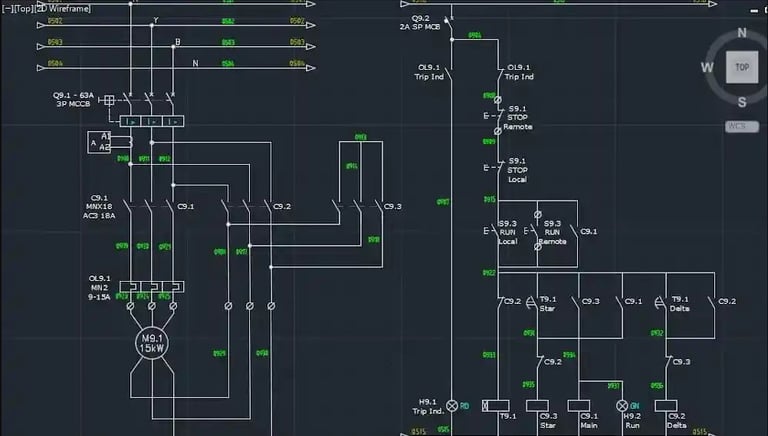
This project focuses on the study, analysis, and practical design of a star–delta starter system, which is widely used in industrial applications for controlling three-phase induction motors. The work was carried out over a duration of six days, emphasizing both conceptual understanding and structured breakdown of the system. The primary goal was to explore how star–delta configurations help in reducing the starting current of motors while maintaining operational efficiency and ensuring safe switching between modes.
The design process involved developing a detailed circuit layout using AutoCAD, where each component, such as contactors, overload relays, timers, and power connections,was carefully arranged to reflect real-world industrial standards. The AutoCAD-based schematic allowed for precise visualization of the control and power circuits, ensuring clarity in connections and proper sequencing of operations. Special attention was given to the interlocking mechanisms between contactors to prevent short circuits during the transition from star to delta configuration, which is a critical safety requirement in such systems.
From a theoretical perspective, the project is based on the principle that during motor startup, connecting the windings in a star configuration reduces the phase voltage, thereby lowering the inrush current. After a specific time delay, the system switches to a delta configuration, allowing the motor to operate at full voltage and deliver rated performance. This transition is typically controlled using a timer relay, which was incorporated into the design and analyzed in terms of timing accuracy and operational reliability.
In developing this project, several standard references and commonly discussed concepts in electrical engineering literature were considered. Topics such as induction motor starting methods, transient current reduction, and protection mechanisms are widely covered in textbooks and research discussions related to industrial motor control systems. General insights were also drawn from commonly available academic and technical papers focusing on motor starting techniques, energy efficiency improvements, and safe switching practices in three-phase systems. These references helped in understanding the importance of minimizing electrical stress on equipment, improving system longevity, and ensuring stable operation in industrial environments.
The project also involved analyzing the practical implications of improper switching, such as voltage dips, mechanical stress, and potential damage to motor windings. By studying these aspects, the design was optimized to include proper sequencing and protective elements, ensuring that the transition between star and delta modes occurs smoothly without causing electrical faults or performance issues. Additionally, the role of overload protection was examined to safeguard the motor against excessive current conditions.
Overall, this work provided a comprehensive understanding of both the theoretical and practical aspects of star–delta systems. The combination of AutoCAD-based design and analytical study helped bridge the gap between academic concepts and real-world applications. It strengthened my knowledge of industrial electrical systems, improved my ability to interpret and design control circuits, and enhanced my awareness of safety and efficiency considerations in electrical engineering projects.
Electrical Circuit Design (Star–Delta System)
Financial Data Analysis Dashboard
This project focused on analyzing company financial data and presenting key insights through a structured dashboard approach over a duration of 12 days. The main objective was to understand business performance by evaluating important financial metrics such as revenue, EBITDA, profit margins, and growth trends, and translating them into clear visual representations.
The work began with collecting and organizing financial data, followed by breaking it down into meaningful segments for analysis. Key performance indicators (KPIs) were identified to evaluate the company’s financial health and operational efficiency. By analyzing revenue trends over time, I was able to observe patterns of growth and fluctuations, which provided insights into business performance across different periods.
A major part of this project involved creating visual charts and graphs to simplify complex data. Using bar charts, line graphs, and comparative visuals, the dashboard was designed to present information in an easy-to-understand format. EBITDA and margin analysis helped in assessing profitability and cost efficiency, while growth trend analysis highlighted the company’s progress and potential areas of improvement.
In addition to visualization, the project emphasized data interpretation. Rather than only presenting numbers, the focus was on extracting meaningful insights that could support decision-making. For example, identifying periods of strong or weak financial performance, understanding cost behavior, and evaluating overall business sustainability. This analytical approach is essential in real-world scenarios where data-driven decisions play a crucial role.
The project also drew on general concepts from financial analysis practices commonly discussed in business and research contexts, such as trend analysis, ratio evaluation, and performance benchmarking. These principles helped in structuring the dashboard in a logical and professional manner.
Overall, this project enhanced my ability to work with financial data, improved my skills in data visualization and interpretation, and strengthened my understanding of how analytical tools can support business decisions. It also helped me develop a more structured approach to presenting data in a clear, concise, and impactful way
Technical Documentation & Report Writing
This project focused on developing structured and professional technical documentation and report writing skills over a period of 17 days. The work involved studying standard documentation practices, analyzing different report formats, and preparing a complete report that effectively presents technical information in a clear, organized, and professional manner. The primary goal of this project was to bridge the gap between technical knowledge and its proper presentation, ensuring that complex ideas can be communicated in a way that is both understandable and impactful.
The process began with understanding the fundamentals of technical writing, including the importance of clarity, structure, and consistency. A well-prepared technical report is not just about presenting data—it is about guiding the reader through the information logically. To achieve this, I focused on organizing the report into standard sections such as introduction, methodology, analysis, results, and conclusion. Each section was carefully developed to maintain a smooth flow of information, allowing readers to easily follow the purpose and findings of the work.
A key aspect of this project was the use of professional formatting techniques. This included incorporating tables, figures, charts, and properly labeled diagrams to support the written content. Tables were used to present structured data clearly, while figures and charts helped visualize complex information, making it easier to interpret. Attention was given to maintaining consistency in fonts, headings, spacing, and alignment to ensure a clean and professional appearance. The formatting was designed to meet commonly accepted academic and industry standards, which is essential for creating credible and presentable documentation.
Another important component was the analytical aspect of the report. Instead of simply presenting raw data, the focus was on interpreting the information and providing meaningful insights. This required a deeper understanding of the subject matter, as well as the ability to explain findings in a concise and logical manner. The analysis section was developed to highlight key observations, trends, and conclusions, ensuring that the report adds value rather than just displaying information.
Throughout the project, I explored general practices and guidelines commonly discussed in technical writing resources and academic materials. Concepts such as structured formatting, data representation, clarity in language, and audience-focused writing were considered while preparing the report. These principles helped in creating a document that is not only informative but also easy to read and professionally presented.
One of the major challenges faced during this project was maintaining a balance between technical depth and readability. Technical reports often involve complex concepts that can be difficult for readers to understand if not explained properly. Simplifying these concepts without losing their meaning required careful wording and thoughtful structuring. It was important to avoid unnecessary jargon while still maintaining the technical accuracy of the content.
Another challenge was ensuring consistency throughout the document. Maintaining uniform formatting across headings, subheadings, tables, and figures required attention to detail. Even small inconsistencies in spacing or alignment can affect the overall quality of a report, so extra effort was needed to review and refine the formatting multiple times.
Time management also played a significant role in this project. Since the work involved both studying and preparing the report, it was necessary to allocate time efficiently between learning concepts and applying them. Drafting, editing, and revising the report required multiple iterations to achieve the desired level of quality.
Additionally, organizing large amounts of information into a structured format was another challenging aspect. It required deciding what information to include, how to arrange it logically, and how to ensure a smooth transition between sections. This process improved my ability to think critically about content organization and presentation.
Despite these challenges, the project provided valuable learning outcomes. It significantly improved my ability to create clear, concise, and professional technical documents. I developed a better understanding of how to present complex information in a structured way, making it accessible to a wider audience. The experience also enhanced my attention to detail, analytical thinking, and overall communication skills.
Overall, this project played an important role in strengthening my documentation abilities, which are essential in both academic and professional environments. Whether it is preparing engineering reports, project documentation, or business analyses, the skills gained from this work will be highly useful in future tasks. It also reinforced the importance of presenting technical knowledge effectively, as good documentation is a key factor in ensuring that ideas, data, and insights are properly understood and utilized.
Future Work
In the future, I aim to expand these works into more practical and advanced applications. This includes developing real-time electrical system simulations, enhancing data analysis with interactive dashboards and automation tools, and improving documentation standards aligned with industry practices.
I also plan to integrate these skills into larger-scale projects that combine engineering, data analysis, and digital solutions for more impactful outcomes.
Acknowledge To

Suchana Yeasmin Tara
Assistant Manager at Electrical CAD Draft Section, Eastern Housing LTD
I would like to express my sincere gratitude to Suchana Yeasmin for her guidance, support, and valuable insights throughout this work. Her direction played an important role in helping me understand practical aspects and complete these projects effectively.