

Self Project
A clear, concise overview highlighting the essence of your work
Floating Solar Power Systems Under Wind Load Conditions: A Bangladesh Perspective on Design, Stability, and Future Implementation
Introduction
As global energy demand continues to rise alongside environmental concerns, renewable energy systems have become a central focus in modern power engineering. Among these, solar energy stands out as one of the most scalable and sustainable solutions. However, land scarcity, especially in densely populated regions, poses a significant limitation for large-scale solar deployment. This challenge has led to the emergence of Floating Solar Photovoltaic (FPV) systems, where solar panels are installed on water bodies such as lakes, reservoirs, and coastal zones.
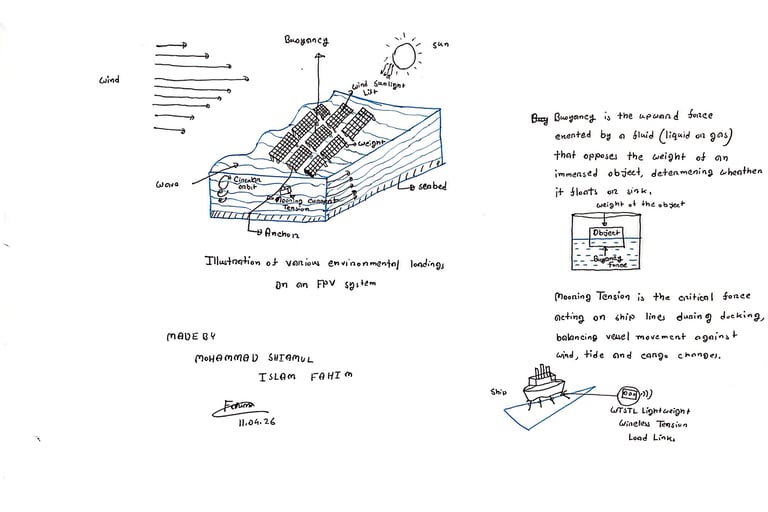
Floating solar systems offer multiple advantages over traditional ground-mounted systems. These include improved efficiency due to natural cooling from water, reduced land usage, and the ability to utilize underused water surfaces. However, unlike conventional solar systems, FPV systems are exposed to complex environmental forces, particularly wind loads, wave action, and hydrodynamic interactions.
Understanding wind-induced forces is critical for ensuring the structural stability and long-term reliability of floating solar installations. In regions like Bangladesh, where seasonal storms and cyclones are frequent, this becomes even more important. This study focuses on analyzing wind load conditions, theoretical modeling of forces, and practical implications for designing floating solar systems in the Bangladeshi context.
Theoretical Method and System Analysis
Wind Load Parameters
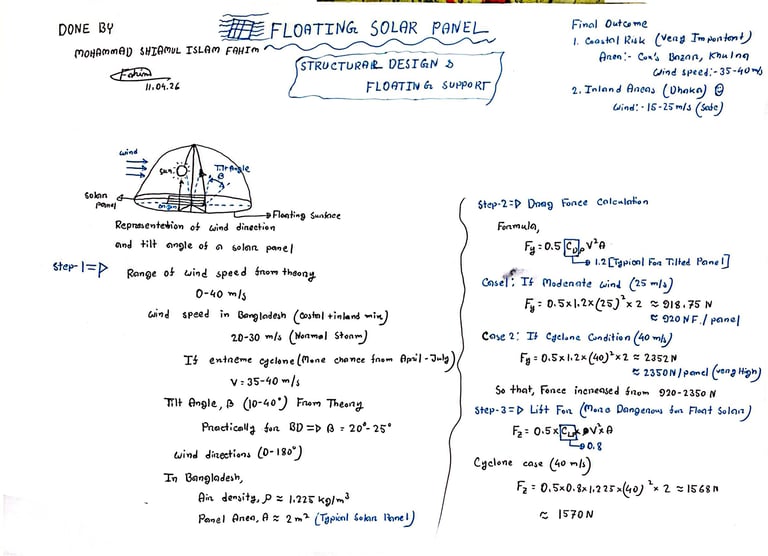
Wind load analysis is essential for determining the forces acting on floating solar panels. The main parameters considered include:
Wind Speed (V): 0–40 m/s
Wind Direction: 0°–180°
Tilt Angle (β): 10°–40°
Air Density (ρ): ≈ 1.225 kg/m³
Panel Area (A): ≈ 2 m² (typical)
The tilt angle plays a crucial role in determining both energy efficiency and aerodynamic behavior. In practical scenarios, especially in Bangladesh, a tilt angle of 20°–25° is considered optimal.
Drag Force (Horizontal Force)
The drag force acts in the direction of wind flow and contributes to structural drift and tension in mooring systems.
The equation used:
Where:
Drag coefficient (≈ 1.2 for tilted panels)
Case Study:
Moderate Wind (25 m/s):
Fy≈920N
Cyclone Condition (40 m/s):
Fy ≈ 2350N ≈ 2350N
This shows that wind force increases significantly with speed due to the square relationship (V²).
Lift Force (Vertical Force)
Lift force acts vertically and is more critical in floating systems because it can destabilize the structure.
Where:
CL ≈ 0.8
Cyclone Condition:
Fz≈1570N
This upward force can lead to:
i. Panel uplift
ii. Structural imbalance
iii. Risk of overturning


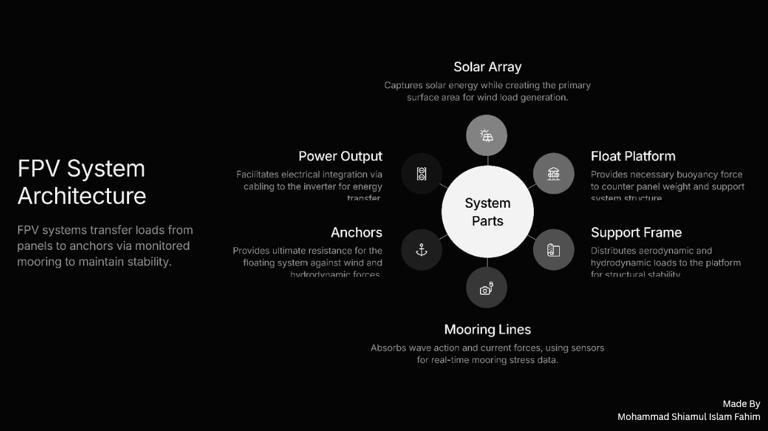
System Architecture
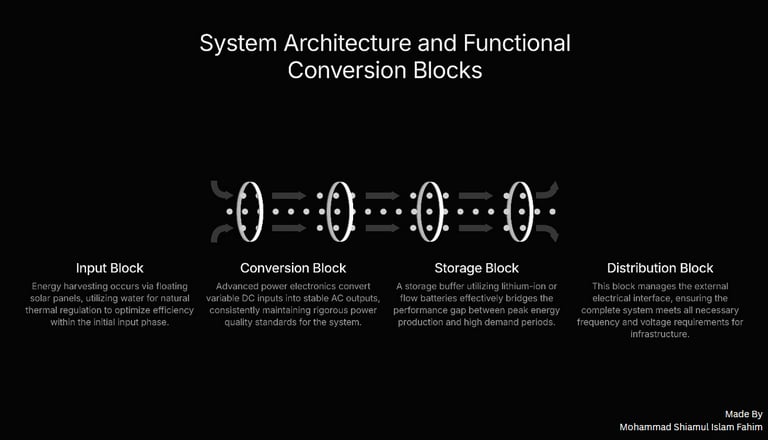
My study correctly divides the system into four main functional blocks:
i. Input Block
Solar panels collect energy
Water provides cooling → improves efficiency
ii. Conversion Block
Inverter converts DC to AC
Maintains stable power output
iii. Storage Block
Batteries store excess energy
Ensures supply during low generation
iv. Distribution Block
Supplies power to grid/load
Maintains voltage and frequency stability
This structured approach reflects a real-world power system design methodology.
Bangladesh Perspective
Bangladesh presents a unique environment for floating solar systems due to its geography, climate, and energy demand.
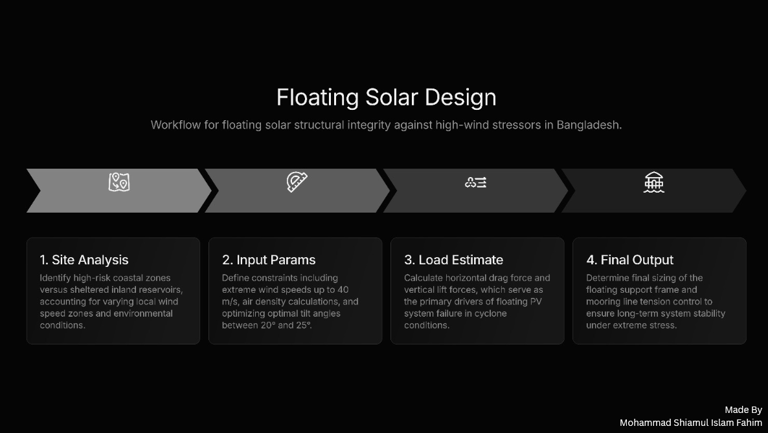
Wind Conditions in Bangladesh
Wind behavior varies significantly between regions:
Coastal Areas:
Wind Speed: 35–40 m/s (cyclone conditions)
High risk due to:
Cyclones
Storm surges
Strong gusts
Inland Areas:
Wind Speed: 15–25 m/s
Comparatively safer
More stable deployment environment
Design Implications
Suitable Locations
Floating solar can be deployed in:
i. Rivers
ii. Reservoirs
iii. Irrigation canals
iv. Coastal water bodies
Bangladesh has abundant water surfaces, making FPV a highly feasible solution.
Energy Opportunity
i. Reduce land dependency
ii. Support rural electrification
iii. Integrate with existing grid systems
Challenges
Despite its advantages, floating solar systems face several challenges:
Extreme Weather Conditions
i. Cyclones and storms can cause structural failure
ii. Requires robust design and testing
Complex Engineering Design
i. Interaction of wind + water forces
ii. Requires multidisciplinary analysis
High Initial Cost
i. Floating structures
ii. Anchoring systems
iii. Installation complexity
Maintenance Issues
i. Corrosion
ii. Biofouling
iii. Accessibility challenges
Lack of Local Expertise
i. Limited experience in FPV systems
ii. Need for research and training